“Make everything as simple as possible, but not simpler."
Starting my month of paid Haiku-work today, I was quite astonished to see the many emotional comments that have been added to the announcement. Clearly, the topic seems to be one of heavy likes and dislikes …
Having read all those comments and most of the discussions we had earlier (on the wiki and on the mailing lists), I felt the need to start my blog with the quote given above - as, for me, that pretty much summarizes what there is to say about package management …
We got a question today on the #haiku channel if there is interest in setting up a Haiku buildbot for Gnash. If anyone is interested join #gnash on irc.freenode.net
http://wiki.gnashdev.org/BuildBot
As you might have noticed, the WiFi encryption bounty ends tomorrow. Obviously, this is a good time to give an overview over what I did in the past weeks. Unfortunately, and hopefully before I got you excited, the most interesting thing of the bounty, the wpa_supplicant, does not work yet. I've ported it to Haiku, but so far it has resisted my attempts to find out where the problem is located -- well, in the hours I put into debugging I've found a couple of potential causes, but there is at least one more to be found, and fixed.
Depending on what kind of projects you write, you may have to create a new file type from time to time, such as a document type for the next Word-killing word processor. While not difficult, making one needs a bit of knowledge from different places in the OS and the API. In our final lesson which focuses on the Storage Kit, we will learn about MIME types, how to show the OS how to automatically identify files of your new type, and more.
A holiday treat! In this lesson we continue to work our way through the Storage Kit, learning about one of the lesser-known features of the Haiku API: node monitoring. For those new to Haiku, it notifies programs of changes to the filesystem, such as changes in a name, etc. If you’re looking to turn a good Haiku app into a fine one, this is one way to do it.
Programming with Haiku, Lesson 14
Haiku has been selected as one of twenty organizations to participate in the 2010 Google Code-In!
From the Google announcement[1]:

Google's contest to introduce pre-university students to the many kinds of contributions that make open source software development possible, is starting on November 22, 2010. We are inviting students worldwide to produce a variety of open source code, documentation, training materials and user experience research for the organizations participating this year. These tasks include:
- Code: Tasks related to writing or refactoring code
- Documentation: Tasks related to creating/editing documents
- Outreach: Tasks related to community management and outreach/marketing
- Quality Assurance: Tasks related to testing and ensuring code is of high quality
- Research: Tasks related to studying a problem and recommending solutions
- Training: Tasks related to helping others learn more
- Translation: Tasks related to localization
- User Interface: Tasks related to user experience research or user interface design and interaction
Since we were picked on November 5th, we have been busy getting our task list in order and putting together a good group of Haiku mentors for this. Many of the tasks are for translations, so we may still need a few more mentors to cover some of those tasks. If you are interested in mentoring please let us know on the mailing list. For a preview of some of the possible Haiku tasks, you can check the wiki page we used for gathering ideas[2].
I’m not talking about databases, either. In this lesson, we examine one of the most distinctive features Haiku has: the query. We get a good, long look into the murky depths that are the query’s official syntax, Reverse Polish Notation, and a few other weird and wonderful tricks. Enjoy!
Programming with Haiku, Lesson 13
Hello Haiku fans!
I am about to kick off a project that will benefit the Haiku community at large by addressing an area that I feel needs attention. Enter the Haiku video tutorial series. An easy to understand guide that will draw viewers into the beautiful Haiku while presenting all the features and work instructions in a plain and concise manner. Not only will these tutorials be designed to teach, they will also drive home a message which will prove that Haiku is the only OS designed from the ground up for use on the desktop PC.
This year’s Google Summer of Code Mentor Summit again fell on the same weekend as BeGeistert. This year Niels was able to make the trip. Niels and I attended the summit representing Haiku. We attended some of the same sessions but split up for others. As was the case last year we met a lot of developers from the other orgs, some I had met either at last years summit or other open source events. I talked with the VLC, FFMpeg and BeagleBoard guys on Friday night. One (or more) of the beagleboard.org guys works for TI in Community Development, and was exited to hear that Haiku was working on an Arm port and suggested he may be able to hook us up with Free Hardware. We may just have to cover the taxes to get such hardware to a developer in Europe is all. I have contacted him and will post an update on this when we get a response.
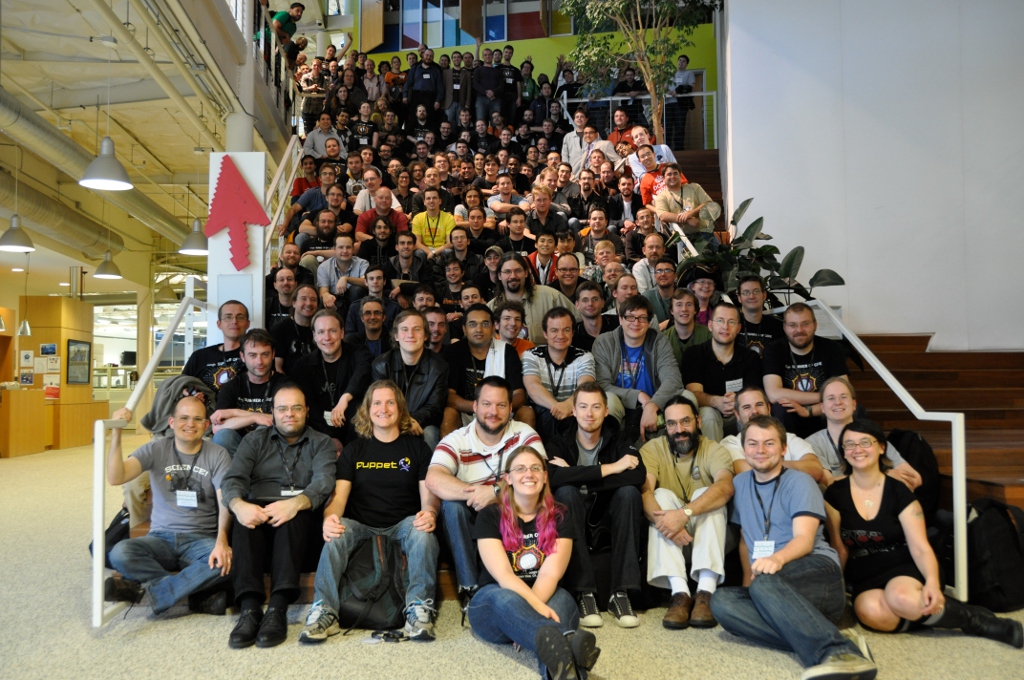
Here’s the group picture. click to see larger view